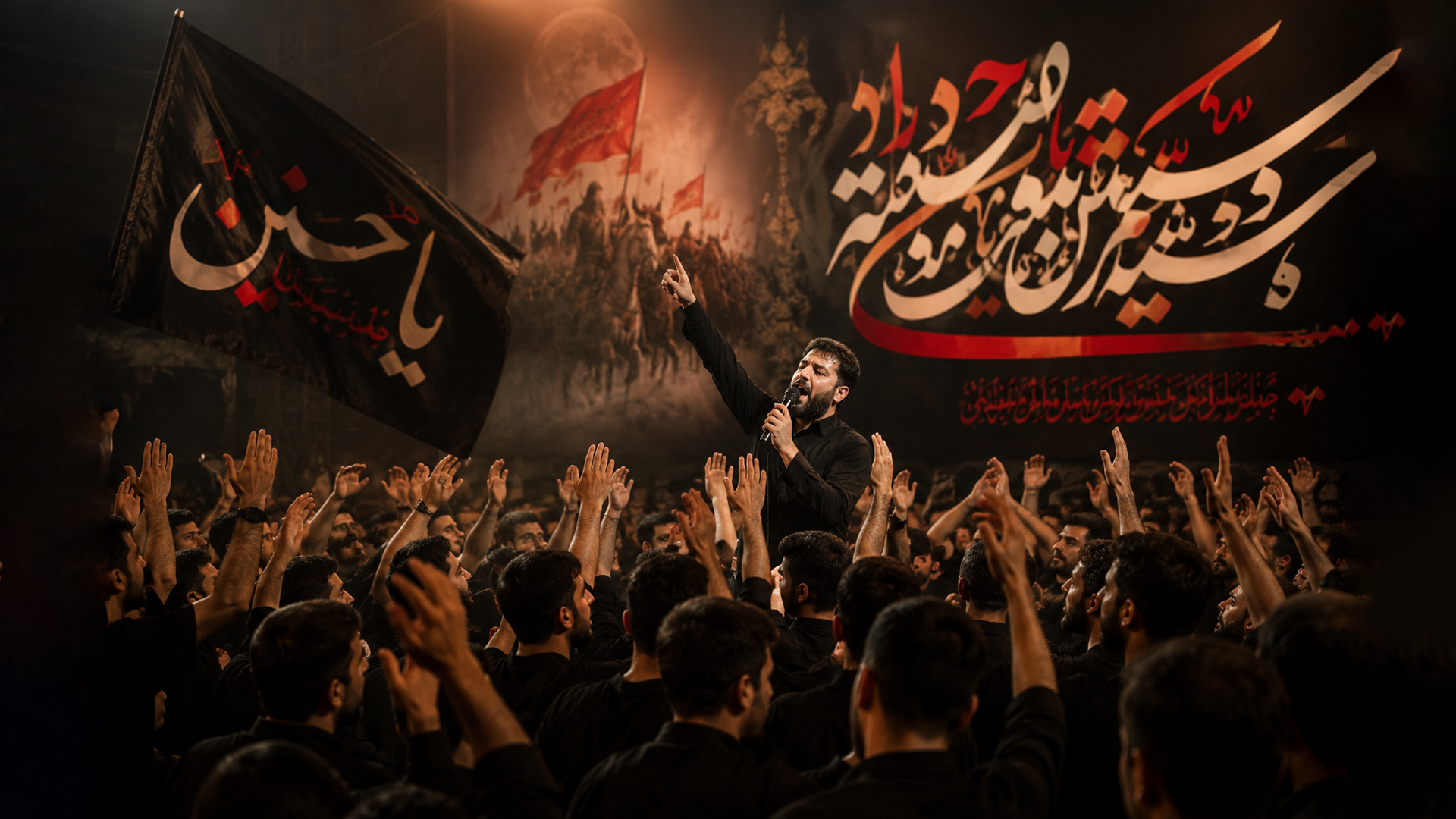
What Is Epic Maddahi?
Epic Maddahi is a distinctive branch of Maddahi, the Persian and Shia religious chanting tradition that turns praise, lament, and sacred history into communal vocal performance. In English-language discussions it is often described as heroic Shia religious chanting, because its central purpose is not only to mourn but also to remember courage, loyalty, sacrifice, and resistance. Epic Maddahi draws on Persian religious poetry, Islamic eulogy, devotional performance, Ashura recitation, and the wider grammar of Shia commemorative culture. Its reciters narrate the deeds of prophets, imams, and martyrs, especially Imam Ali and Imam Husayn, with a strong emphasis on battlefield scenes, moral resolve, and the emotional bond between the reciter and the audience. The form can be solemn or thunderous, intimate or processional, but it always joins text, melody, rhythm, and collective response. For listeners outside Iran or Shia communities, epic Maddahi may first sound like a hymn, a chant, or a poem sung in public. In practice it is a complex art of memory that carries theology, history, ethics, and community identity in a single performance. This article explains what epic Maddahi is, where it comes from, how its poetry and performance work, why it matters, and how modern media are changing it.
Historical Roots and Religious Context
Epic Maddahi did not appear as an isolated genre. It grew from several overlapping traditions: Persian panegyric poetry, religious elegy, mourning assemblies, Sufi-inspired devotional poetry, and the oral storytelling of sacred history. In Shia communities, commemorations of Muharram and Ashura created a yearly cycle in which grief, praise, and heroic remembrance came together. Reciters learned to move between tender lament and forceful narration, depending on the moment and the audience. The epic strand of Maddahi became especially associated with stories of Karbala, where the language of suffering is never separated from the language of dignity and resistance. Over time, maddahs developed repertoires that could be sung in mosques, community halls, processions, and private gatherings. The art also absorbed features of Persian epic poetry, including vivid battle imagery, direct address, repetition, and a strong sense of moral contest between justice and tyranny. This does not mean that every epic Maddahi is a historical chronicle. Many performances compress events, heighten emotion, and use symbolic images so that listeners remember not only what happened but also what the community is called to value. The result is a religious art that is also a social art, shaped by local dialects, regional melodies, clerical guidance, audience expectations, and the changing technologies of sound.
Poetry, Meter, and Heroic Imagery
The poetry of epic Maddahi is built for oral delivery. It often uses regular meter, refrains, and repeated phrases that let a crowd join in or respond at the right moment. A reciter may begin with praise, move into narrative, pause for reflection, and then return to a refrain that gathers the audience into a single voice. The language is concrete and symbolic at once: banners, deserts, swords, horses, rivers, tents, dust, chains, and dawn are used not as decorative details but as signs of loyalty, suffering, and triumph. Epic Maddahi frequently employs apostrophe, in which the reciter addresses a martyr or a sacred figure directly, and this direct address creates intimacy. The audience is not simply hearing a story about the past; it is placed inside a drama of faithfulness and decision. Persian religious poetry gives the genre a rich vocabulary for praise and grief, while local languages and dialects add immediacy. Some texts are learned from classical poets, while others are composed by contemporary maddahs and adapted to particular occasions. The best epic Maddahi avoids empty bombast. It balances heroic tone with human vulnerability, since the power of the genre depends on showing that courage exists alongside fear, loss, and love. This balance helps listeners feel that the sacred history speaks to their own struggles and responsibilities.
- Regular meter and refrain support collective participation.
- Heroic images turn memory into moral instruction.
- Direct address creates emotional closeness with sacred figures.
- Repetition helps the audience remember key phrases and themes.
Performance Style and the Role of the Reciter
The maddah, or reciter, is central to epic Maddahi. The reciter must be more than a singer with a good voice. A skilled maddah controls breath, pace, volume, silence, and emotional timing. The voice may rise into a strong declaration, soften into lament, or pause long enough for the audience to absorb a line. Percussion is common in many settings, especially the daf or dayereh, and the beat can shift from a measured march to a faster pulse that carries collective chanting. Yet epic Maddahi is not defined by instruments alone. In many religious settings the unaccompanied voice, or voice with restrained percussion, is preferred because the focus should remain on the text and its message. The audience is also a performer. Listeners respond with refrains, tears, raised hands, or repeated phrases, and this interaction shapes the reciter's choices. A good performance feels dialogic rather than fixed. The reciter reads the room, extends a refrain when the crowd is ready, and changes intensity according to the occasion. This is why recordings cannot fully capture epic Maddahi. The genre lives in the relationship between a voice, a text, a place, and a gathered community. The reciter's authority comes from training, reputation, religious knowledge, and the ability to serve the occasion rather than draw attention to the self. When that balance is maintained, epic Maddahi can be both aesthetically powerful and spiritually serious.
Epic Maddahi in Muharram and Ashura Commemoration
Muharram and Ashura provide the most visible setting for epic Maddahi. During these commemorations, communities remember the martyrdom of Imam Husayn and his companions at Karbala. The mood includes grief, but it also includes protest against injustice, loyalty to principle, and admiration for those who stood firm. Epic Maddahi plays a special role in this emotional and moral landscape. It can narrate the journey to Karbala, describe the courage of the companions, honor the family of the Prophet, and call listeners to reflect on their own commitments. The genre can move from praise to lament within a single session, showing that heroism and sorrow are intertwined. In processions, the rhythm of epic Maddahi helps coordinate movement and collective participation. In indoor gatherings, the same texts may be performed more slowly, with greater emphasis on poetry and reflection. This flexibility is one reason the genre has survived across different social settings. It can be public and loud or intimate and contemplative. It can serve as a memorial, a summons, a lesson, and a bond of solidarity. The most thoughtful performances avoid reducing Karbala to spectacle. They keep attention on the ethical meaning of sacrifice and on the community's responsibility to remember the vulnerable, resist tyranny, and practice justice in daily life.
How Epic Maddahi Differs from Lament and Sermon
Epic Maddahi is often confused with related Shia religious forms, but its emphasis is distinct. A nawha is primarily a lament, focused on grief and mourning, often with a repetitive melodic structure that invites weeping and participation. A rowzeh is a religious assembly in which a speaker narrates and interprets sacred history, blending storytelling with exhortation and moral teaching. A marsiya is an elegy, a poetic work of mourning that may be recited or sung. Epic Maddahi can include elements of all these forms, but its characteristic energy is heroic. It highlights courage, steadfastness, and the dignity of resistance. This does not make it less emotional than lament. Rather, it directs emotion toward resolve and identification. The reciter may praise a martyr's bravery, describe a moment of moral choice, and then invite the audience to carry that example into life. In practice, the boundaries are fluid. A single gathering may include sermon, elegy, lament, and epic chanting. The categories help listeners understand emphasis, not rigid separation. Understanding the difference matters because epic Maddahi is sometimes misread as mere performance or entertainment. Its heroic register is consciously ethical: it asks what it means to stand with truth when standing is costly. That question gives the genre its enduring seriousness.
Community, Identity, and Ethical Instruction
Epic Maddahi does more than preserve stories. It helps form community identity. For many Shia communities, the sound of Maddahi signals belonging, memory, and shared values. It marks time through the religious calendar and gives public expression to private devotion. Families learn refrains together, young people imitate respected reciters, and older listeners remember performances from earlier decades. The genre also transmits ethical instruction. Stories of loyalty, hospitality, courage, patience, and sacrifice become models for conduct. This teaching works not through abstract argument but through image, rhythm, and repetition. A line about standing firm in the face of pressure can stay with a listener long after the gathering ends. Epic Maddahi can also create solidarity across differences of class, region, and generation, though it is never socially neutral. It reflects the concerns of the communities that perform it, including debates about religious authority, national identity, gender roles, and political responsibility. Good scholarship and responsible listening should notice these dimensions rather than treating the genre as timeless emotion. The art is traditional, but tradition is lived and argued over. Its ethical force depends on how communities interpret it and whether they connect heroic memory to present-day justice, care for neighbors, and honest speech. When epic Maddahi is reduced to nostalgia or spectacle, its moral edge is weakened; when it is received thoughtfully, it can challenge listeners to live with greater courage and compassion.
Modern Media, Diaspora, and Changing Audiences
Modern media have transformed epic Maddahi without replacing its communal core. Recordings, television broadcasts, websites, and social platforms allow performances to travel far beyond the hall or neighborhood where they began. Diaspora communities can hear reciters from their home regions and share favorite sessions with children growing up in other languages and cultures. Young maddahs can build reputations quickly, and audiences can compare styles across cities and countries. This access has advantages: it preserves rare performances, supports religious learning, and keeps communities connected. It also creates pressures. Short clips favor dramatic moments over long poetic development. Commercial attention can encourage showmanship. Standardized recordings may make local styles seem less important. At the same time, new media allow experimentation, including translations, subtitles, youth-oriented formats, and conversations about the genre's history and meaning. The challenge is to use technology without flattening the art. Epic Maddahi depends on context, patience, and participation. A sixty-second clip can introduce a reciter, but it cannot reproduce the shaped arc of a full session. Communities that value the genre often invest in teaching poetry, voice, religious knowledge, and performance ethics. They recognize that the future of epic Maddahi is not only a matter of preserving old recordings but also of forming new reciters and thoughtful audiences. In a globalized setting, the genre must speak across languages while remaining rooted in Shia religious life and the specific histories that give its images meaning.
Studying Epic Maddahi with Respect
For researchers, journalists, and curious listeners, epic Maddahi should be approached with attention to both art and belief. It is not enough to admire the voice while ignoring the theology. It is also not enough to treat the genre only as doctrine while ignoring its aesthetic craft. A respectful study asks who performs, for whom, on what occasion, and with what authority. It listens to the poetry closely, notices refrains and metaphors, and considers how the audience participates. It distinguishes between different regional styles and avoids assuming that one recording represents the whole tradition. It also recognizes that epic Maddahi is living practice, not a museum object. Practitioners may disagree about proper instrumentation, vocal style, language, and the balance between lament and heroic narration. These disagreements are part of the tradition's vitality. Non-specialists should be cautious about sensationalizing grief or turning sacred history into spectacle. The most useful approach is to learn from practitioners, read reliable scholarship, and pay attention to context. This kind of listening does not diminish appreciation. It deepens it, because epic Maddahi becomes intelligible as a complete art of memory, faith, and communal responsibility rather than a curious sound from a distant culture.
Conclusion
Epic Maddahi is a powerful form of Shia religious chanting that joins heroic narrative, poetry, melody, rhythm, and collective response. Its roots lie in Persian religious poetry, mourning assemblies, and the commemorative culture of Muharram and Ashura, but its concerns are wider: courage, justice, loyalty, sacrifice, and the duty to remember. The genre is flexible enough for processions and intimate gatherings, for classical texts and new compositions, for local dialects and global media. It is also demanding. It requires skilled reciters, attentive audiences, and communities that understand the difference between shallow spectacle and serious devotional art. As media change and diasporas grow, epic Maddahi faces new opportunities and new pressures. Its future will depend on teaching, thoughtful performance, and responsible listening. For anyone seeking to understand Shia religious culture, epic Maddahi offers a rich entry point. It shows how memory can be sung, how grief can become resolve, and how a community can gather around a story that asks listeners to live with greater courage and compassion.